Showing posts with label Review. Show all posts

Friday, April 18, 2008

First Thoughts: Valentine One Radar Detector


Up until recently, I thought radar detectors would only serve to guarantee you a ticket when you got pulled over.  I had read multiple articles about how they aren't really that effective, and if you had one mounted to your windshield, a police officer would be almost guaranteed to write you a ticket (as opposed to a warning) if pulled over.  
However, after using a Valentine One radar detector, I can honestly say that this is a huge improvement over the next best competitor.  As I drove down the highway coming back to school after purchasing one of these units, the detector produced no false alarms, and gave me a good 20-30 seconds of warning if there was a speed trap ahead.  This gave me adequate time to double check my speed and ensure I was safe from, as the V1 website calls them, "bogies."  While I realize that speed limits are put into place as protection against ourselves, I think speeding within reasonable limits is acceptable.  This device helps to be better aware of what is around, while allowing me to concentrate more on driving, rather than trying to search out the next uniform hiding under the bridge.
On top of the highly selective detection hardware that filters out false alarms, the Valentine has one feature that no other offers - arrows.  Arrows might not seem very logical for a radar detector, but the device interprets the radar it detects and gives you the direction, strength, and number of radar streams it detects.  For example, if you get four simultaneous signals from in front, behind, and to the sides, you can be almost fully assured that you're picking up microwave signals from a grocery store door system or the like.  On the other hand, if you get one slowly building signal from ahead, you can be almost guaranteed that you're approaching a speed trap.  The inventor of this system has written many articles on the V1 website as to how these signals can be interpreted and what each most likely means.
Overall, the V1 has saved me me from a speed trap on almost every highway trip I've taken since I started using it.  If you're one to speed, this is the detector to get, and while the price is steep at an MSRP of $399, used units can be had for around $250 on ebay.  The V1 website does a superb job of explaining the unit and how it can be best utilized.  Check it out.  Here's a link to their store.

Wednesday, February 27, 2008

Feeling Lost?


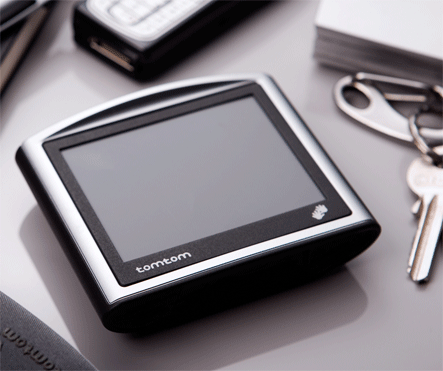
The days of “Mapquesting” around town may be over. Global Positioning Systems, more commonly known as GPS units, are getting smaller, smarter, and most importantly, more affordable by the day. One of the most simple units on the market, the TomTom One is small enough to fit in a pocket, yet packed with features enough to fill the trunk of a car. The TomTom one is used in the same way one would use Mapquest to get from point A to point B. Give it a destination, the unit pauses for a moment, calculates the fastest route, and within ten seconds begins visual as well as voice guidance to your selected destination. The main difference between using GPS and using Mapquest is that you get live guidance throughout the trip as well as the ability to recalculate your route if you miss a turn or there is a road closed.

The main idea behind the TomTom one was to go back to basics and create a GPS unit that does its one task dutifully and without any extra bells and whistles to deal with. This mindset makes the TomTom one perfect for first-time buyers who need a very user-friendly experience. It does navigation, and that’s it. There are three ways that the TomTom can route the driver: by fastest route, shortest route, or avoiding highways. The unit defaults to the fastest route option which is best for most situations, but if, for example, the traffic report on the radio just said that the interstate is backed up this morning, the option to avoid freeways suddenly comes in very handy. If there’s an accident ahead or a road closed, you can tell the TomTom to avoid that particular street, and within another few seconds you’re on your way with a new route, and that’s just getting around town!

The most efficient use of a GPS unit such as the TomTom One would be getting to areas you’re unfamiliar with. The TomTom One could calculate the fastest route from San Diego, CA to Boston, MA in about 10 seconds and guide the driver turn by turn the entire way there – including navigating to gas stations, rest stops, restaurants, hotels, and anything else one might need on a road trip. The unit comes preloaded with maps of the entire US and Canada, as well as maps of Europe, and other areas of the globe can be added via a PC.

Granted, this convenience doesn’t come for free! This unit sells for an MSRP of $499 – a hefty price for most students. For a much reduced hit to your wallet, check out the Garmin StreetPilot i2 which, while not quite as user friendly, is a very usable solution that can be found online for around $219. And if you happen to have a bit more cash to spend, check out the $599 TomTom Go 700 for added features such as live traffic information which will detect and automatically route you around any a accidents or traffic jams and on to your destination.

Get Away From it All


Sound isolating headphones allow users to block out outside noise and let their music take over their ears for a much more pleasurable and detailed listening experience. If you’re looking to get away from everything and just enjoy your music, the Shure E2C headphones will most certainly get the job done.

Try this – put your fingers in your ears. Let everything else drown out and listen closely. You can hear your own heart beat. You can hear your lungs draw in and release each breath. Now imagine the ends of your fingers have high definition speaker drivers on them; this is the experience you get with Shure headphones – nothing short of incredible. Suddenly, you’ll hear things you’ve never heard before in songs you’ve heard fifty times. The bass is rich and deep – granted, these headphones can’t vibrate your chest like a 12” subwoofer can, but your eardrums can’t tell the difference. The treble is crisp, sharp, and cool; vocals as clear as listening to a live acoustic session. These things are seriously the crème of the crop.

In addition to their noise-canceling qualities, these headphones are much more comfortable than normal headphones and are fit to be worn for many hours at a time without discomfort. Whether you’re walking around, on an airplane, or even – gasp – in class, you’ll be able to leave and get into your own little world with whatever music you choose. Naturally, these aren’t the $15 Philips headphones at Walgreens. The hit to your wallet is a rather hefty MSRP of $99.99 although Amazon carries them for $68. For a slightly lighter wallet you can shoot for Sumajin’s $45 sound isolating SEP-001 headphones, or if money is not an issue, the $220 Shure E4c’s are a very nice upgrade that are much smaller and lighter, but pack the same sound quality.